
Missouri DOR Permit Practice Test 44
- Questions25
- Correct to pass20
- Passing score80%
- Minimum age15 years
-
1. A flagger turns the paddle to the orange face reading SLOW. What does that tell approaching drivers?
Show answer
Answer D: Reduce speed and continue through the work area with care
The SLOW face keeps traffic moving at a reduced speed while workers or equipment are close to the travel lanes.
-
2. Why is parking against the flow of traffic dangerous even when nobody complains?
Show answer
Answer D: Because you had to cross traffic to get there and must cross again to leave
Parking on the wrong side means driving against traffic at both ends of the stop, and your reflectors and lights face the wrong way while you are there.
-
3. What does a flashing yellow traffic light mean?
Show answer
Answer B: Slow down and proceed with caution
A flashing yellow lets you enter the intersection cautiously after yielding to pedestrians and to conflicting traffic that is already there.
-
4. On an unlit road, about how far ahead do high beams normally let you see?
Show answer
Answer D: About 350 to 500 feet ahead of the vehicle
High beams light roughly 350 to 500 feet of road and low beams far less, which is why night speeds have to be chosen around the beam, not the limit.
-
5. An arrow panel in a work zone shows four flashing lamps in caution mode instead of an arrow. What does that display mean?
Show answer
Answer A: Warning only, so pass the work area with caution in your current lane
Caution mode gives a general warning without directing a lane change, so drivers stay alert and pass the activity with care.
-
6. You arrive at an intersection with no signs, no signals and no markings at the same time as a vehicle on the road to your right. What must you do?
Show answer
Answer B: Yield to the vehicle on your right
At an uncontrolled intersection you must yield to a vehicle already in the intersection or approaching from your right.
-
7. Your road ends at a T-intersection with no signs or signals. Who has the right-of-way?
Show answer
Answer A: Traffic on the through road, and you must yield before entering
A driver on a road that ends at a T-intersection must yield to traffic on the through road that continues past the junction.
-
8. You see an open curb space on the opposite side of a two-way street. What should you do?
Show answer
Answer B: Drive on, turn around, and come back on that side
You must park on the right, facing the direction of travel, so reaching a space on the other side means going around rather than crossing into it.
-
9. You want to reverse direction but the street is too narrow for a U-turn. What is the alternative?
Show answer
Answer D: Make a three-point turn, or go around the block in heavy traffic
Where there is not enough width for a U-turn, the three-point turn does the job in stages, and on a busy street going around the block is safer still.
-
10. A signal stands part way up a freeway entrance ramp and turns green briefly again and again. How many vehicles does such a signal normally release on each green?
Show answer
Answer A: One for each lane of the ramp
A ramp control signal releases a single vehicle per lane on each green so that vehicles reach the merge one at a time instead of in a bunch.
-
11. Why is being thrown out of a vehicle in a crash so dangerous?
Show answer
Answer C: Because you strike the road or other objects at high speed, and rarely survive
Ejection is one of the deadliest outcomes of a crash, and a fastened belt is what keeps a person inside the vehicle.
-
12. A driver has to stop for a train at this sign. How far back from the nearest rail should the vehicle be held?

Show answer
Answer C: No closer than roughly fifteen feet
A train and its load overhang the rails, so stopping no closer than about fifteen feet keeps the vehicle outside the space the train actually sweeps.
-
13. The traffic signal is green, but the crossing lights on the tracks inside the intersection begin to flash. What must you do?
Show answer
Answer C: Stop clear of the tracks and wait, even though the signal is green
Active crossing warning devices outrank the green indication, so you stop short of the rails and wait until the warning stops.
-
14. You are in the acceleration lane and the gap you were aiming for is now beside you. What is the best adjustment?
Show answer
Answer A: Change your speed a little to line up with a gap, then merge smoothly
The acceleration lane is for matching both the speed and the position of a gap, and small speed adjustments are what line the two up.
-
15. About how far does a vehicle travel in one second at 60 mph?
Show answer
Answer A: About 88 feet
At 60 mph you cover about 88 feet every second, which is why a glance of only two or three seconds means driving the length of several vehicles blind.
-
16. You are about to open your door after parking on the traffic side of the street. What should you do first?
Show answer
Answer C: Check the mirror and look back for approaching vehicles and bicyclists before opening the door
A door opened into traffic can strike a passing bicyclist or vehicle, so you check behind you first and keep the door open no longer than necessary.
-
17. Where are children in the greatest danger around a school bus?
Show answer
Answer B: In the roadway right around the bus, especially in front
The danger zone is the band of roadway around the bus where the driver's view is poorest, and children crossing in front of the bus are hardest to see.
-
18. When should headlights be switched on besides during the hours of darkness?
Show answer
Answer C: Whenever rain, fog, snow or dust makes it harder to see or to be seen
Headlights are as much about being seen as about seeing, so they go on whenever visibility drops.
-
19. Your car begins to lose power on a freeway and you must stop. Where should you try to bring it to a halt?
Show answer
Answer A: As far off the right side of the road as you can get, beyond the edge line
A disabled vehicle should be moved completely clear of the travel lanes, on the right, so that traffic can pass without changing course.
-
20. An emergency vehicle with flashing lights and a siren is approaching from behind on a two-way street. What should you do?
Show answer
Answer C: Pull over to the right edge of the road and stop until it passes
Clearing a path by pulling to the right and stopping gives the emergency vehicle a predictable route, while stopping in mid-lane or inside an intersection blocks that path.
-
21. How is the yield sign shaped and colored?
Show answer
Answer C: A downward-pointing triangle with a wide red border and a red legend on white
The yield sign is a downward-pointing equilateral triangle with a wide red border and the legend in red on a white background, an outline used for no other message.
-
22. A crossing guard steps into the roadway ahead of this sign with one hand raised. What must the driver do?
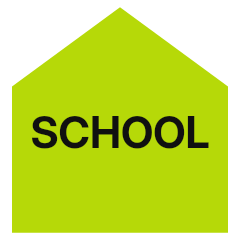
Show answer
Answer B: Stop and stay stopped until the guard waves traffic on
An adult guard is controlling traffic at that crossing, so the instruction given by that person governs and the driver waits to be released.
-
23. You see smoke coming from under the hood while driving. What should you do?
Show answer
Answer D: Signal, pull well off the road, shut off the engine and move everyone away from the vehicle
Stopping and shutting off the engine cuts the fuel supply to a possible fire, and distance protects you if it spreads. Raising the hood can feed the fire a rush of air.
-
24. A yield sign is posted where an entrance ramp meets the highway. What must you do?
Show answer
Answer C: Give way to the traffic already on the highway and merge into a gap
The yield sign confirms that the merging driver is the one who must fit into the traffic stream rather than the other way round.
-
25. Your lane is ending ahead in slow, heavy traffic and drivers in the next lane are already bumper to bumper. What is the recommended way to merge?
Show answer
Answer C: Take turns, one vehicle from each lane at the merge point
Alternating one for one at the merge point keeps both lanes moving and is the safest way to combine slow traffic.