
Missouri DOR Permit Practice Test 51
- Questions25
- Correct to pass20
- Passing score80%
- Minimum age15 years
-
1. Under Missouri's electronic communication device law, what is prohibited while the vehicle is in motion?
Show answer
Answer A: Physically holding or supporting a cellphone with any part of the body
Missouri bans holding or supporting a phone with any part of the body, along with manual texting and video recording or watching; voice-operated, hands-free and navigation uses remain allowed.
-
2. You are at a red light where right turns on red are allowed, you cannot see clearly, and the driver behind sounds the horn. What should you do?
Show answer
Answer C: Stay stopped until you can see that the turn is safe
Turning right on red is permitted, never required, so you wait until you can see that the way is clear no matter what the driver behind does.
-
3. A yellow sign ahead of an underpass reads LOW CLEARANCE 12 FT 6 IN. What does the figure tell you?
Show answer
Answer B: The greatest height that can pass beneath the structure
The figure is the actual clearance available, so a vehicle taller than that must leave the road and take a marked alternative route.
-
4. What should you do before leaving a parked vehicle unattended?
Show answer
Answer C: Set the parking brake, place the transmission in park or in gear, switch off the engine and take the key
Securing the vehicle with the parking brake, the transmission and the ignition prevents it from rolling away and from being moved by someone else.
-
5. Your vehicle has antilock brakes. What should you never do in an emergency stop?
Show answer
Answer A: Pump the pedal up and down
The system already releases and reapplies the brakes many times a second. Pumping the pedal interrupts it and makes the stop longer.
-
6. A child has outgrown the rear-facing seat. What comes next?
Show answer
Answer D: A forward-facing seat with a harness, used up to its own stated limits
The stages run rear facing, then forward facing with a harness, then a booster, then the adult belt alone.
-
7. A wheel comes off your car while you are driving. What should you do?
Show answer
Answer A: Hold the wheel firmly, ease off the gas and steer gently to the shoulder
A firm grip and a gradual slowing keep the vehicle straight, while hard or sudden braking makes a damaged corner pull the car out of line.
-
8. An arrow panel at a work zone displays a flashing arrow pointing to the left. What does it require?
Show answer
Answer C: Move out of the closed lane into the lane on the left
A flashing or sequential arrow on an arrow panel directs traffic out of a closed lane and into the lane the arrow points to.
-
9. Why does a dirty windshield matter much more at night than during the day?
Show answer
Answer C: Dust and streaks scatter oncoming light and increase glare
Film and streaks on the glass spread every oncoming headlight into a star of glare, so clean the inside as well as the outside before a night trip.
-
10. You are traveling at 55 mph on a rural road and come up behind a horse-drawn buggy. What is the main danger?
Show answer
Answer D: You close on it very quickly because it moves at walking pace
A buggy travels only a few miles an hour, so the gap closes far faster than drivers expect and there is very little time to brake once you see it.
-
11. A bicyclist is riding around a single-lane roundabout in the middle of the lane as you wait to enter. What is your duty?
Show answer
Answer C: Yield to the bicyclist just as you would to a car
A bicyclist using the roundabout is traffic like any other vehicle and has the same claim to the circulating lane.
-
12. You are turning left from a two-way street onto another two-way street. Where should you begin and end the turn?
Show answer
Answer B: Begin in the lane just right of the center line and finish just right of the center line of the new street
You approach a left turn from the lane closest to the center line and enter the new roadway just to the right of its center line, which keeps you clear of oncoming traffic.
-
13. Why is it useful to watch the vehicle two or three places ahead of you?
Show answer
Answer C: You get an earlier warning of slowing traffic than brake lights give
Trouble travels back through a line of traffic, so seeing it start several vehicles ahead gives you a head start on braking.
-
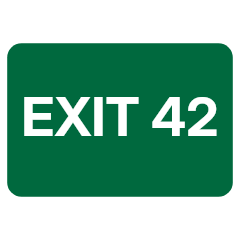
14. Where is signing of this kind normally placed along a freeway?
Show answer
Answer D: Ahead of the interchange and again at the exit, so a driver can reach the correct lane in time
Guide information for an interchange is repeated on the approach and at the ramp, because a driver who learns about the exit only at the last moment has no room left for a safe lane change.
-
15. What is wrong with steering through a turn using the palm of one hand on the wheel?
Show answer
Answer D: You have less control and cannot correct quickly if something goes wrong
One-handed palming gives poor leverage and slow response. Use hand-to-hand or hand-over-hand steering with both hands so you can react instantly.
-
16. How long should a young child ride in a rear-facing child seat?
Show answer
Answer D: Until the child outgrows the height or the weight limit of the seat
Rear facing is the safest position and should be kept until the child reaches the top height or weight allowed by the seat.
-
17. The red brake warning light stays on after you release the parking brake. What should you do?
Show answer
Answer D: Stop safely and have the brakes checked before driving on
With the parking brake released, that light points to low fluid or a fault in one half of the braking system, which can leave you with very little braking.
-
18. The vehicle you want to pass is traveling close to the speed limit. What should you do?
Show answer
Answer C: Stay behind, because a pass may not take you over the limit
The speed limit applies while passing too. If you cannot complete the pass without exceeding it, do not start the pass.
-
19. How much moving water is generally enough to float and carry away most passenger vehicles?
Show answer
Answer D: About one foot
About a foot of moving water will float most cars, and even less will stall an engine. That is why the rule is to turn around instead of judging the depth.
-
20. At what tread depth should a tire be replaced?
Show answer
Answer A: When the tread is worn down to 2/32 of an inch
At that depth a tire loses grip quickly, especially on wet roads, and the built in wear bars or the penny test both show when the point has been reached.
-
21. A driver ahead of you extends the left arm straight out horizontally through the window. What is being signaled?
Show answer
Answer C: A left turn
The left arm held straight out is the standard hand signal for a left turn.
-
22. A deer suddenly steps onto the road ahead of you at night. What is the safest response?
Show answer
Answer C: Brake firmly and stay in your lane rather than swerving
Swerving at speed often leads to a rollover or a head-on crash that is far worse than hitting the animal. Brake hard, hold your lane and expect more deer to follow.
-
23. You are approaching a horse and rider on a country road. What about your horn?
Show answer
Answer C: Do not sound it at all, because the noise can frighten the animal
A startled horse is dangerous to its rider and to you, so pass wide and slow and leave the horn alone.
-
24. After a crash your door will not open and you need to get out of the car. What should you try?
Show answer
Answer B: Try another door of the vehicle, or a window that will still open properly
A jammed door is common after an impact, and the simplest escape is a different door or a window rather than forcing the damaged one.
-
25. What is worth carrying in the vehicle during a winter trip?
Show answer
Answer A: A blanket, a flashlight, a scraper and a small shovel
A winter kit keeps you warm and visible if you are stopped for hours, and lets you clear glass and dig the wheels out. Hot water can crack cold glass.