
Missouri DOR Motorcycle Practice Test 10
- Questions25
- Correct to pass20
- Passing score80%
- Minimum age15 years 182 days
-
1. In the T-CLOCS pre-ride inspection, what does the first item cover?
Show answer
Answer C: Tires and wheels
T stands for tires and wheels, where the rider checks pressure, tread, damage, rims, spokes and bearings before anything else.
-
2. An upward-pointing pentagon with a yellow legend and border on a blue background is used as
Show answer
Answer D: a county route marker
The pentagon serves both the school warning series and county route markers, and the blue background with yellow legend identifies the county route version.
-
3. Why should two riders never travel side by side in the same lane?
Show answer
Answer B: Because neither rider has room to swerve if a hazard appears
Riding directly alongside another motorcycle removes the escape path each rider needs to avoid a hazard, a pothole or another vehicle.
-
4. What is the maximum fine for a second Missouri hands-free violation within 24 months of the first?
Show answer
Answer D: $250
A second violation within 24 months carries a fine of up to $250 under Missouri's hands-free law.
-
5. How long can cannabis affect a driver?
Show answer
Answer A: For hours after the strongest effects have passed
Slowed reactions, poor tracking and weak judgment of distance can last for hours, well beyond the point where the user believes the effects are over.
-
6. What is the benefit of looking far down the road rather than just ahead of the hood?
Show answer
Answer A: You steer with smaller corrections and you see trouble in plenty of time
A distant view steadies your steering and gives you time to plan, because you meet hazards after you have already seen them.
-
7. It is dusk and a jogger in dark clothing is running along the edge of the road. What should you do?
Show answer
Answer D: Slow down and scan the edges of the road
Dusk is the hardest light for spotting people, and dark clothing removes most of your warning, so lower speed and a careful scan of the roadsides are the answer.
-
8. Loose gravel has been swept into the middle of your lane on a downhill bend. Which controls are affected most?
Show answer
Answer D: Steering and braking, since the loose stones roll under the tires
Gravel rolls between rubber and pavement, so the tires can neither turn the vehicle nor slow it as they would on a clean surface.
-
9. You are circulating in a roundabout and a vehicle is waiting to enter ahead of you. What should you do?
Show answer
Answer D: Keep going, because circulating traffic does not stop for entering vehicles
Stopping in the circle to be polite surprises the drivers behind you and defeats the design; entering traffic is the side that waits.
-
10. Why should baggage be kept as low as possible on a motorcycle?
Show answer
Answer C: A high load raises the center of gravity and makes the machine unstable
Weight carried high changes the balance of the motorcycle and makes it feel top heavy in turns and in crosswinds.
-
11. When should you arrange your way home if you plan to drink?
Show answer
Answer C: Before the first drink
Judgment is the first thing alcohol weakens, so the plan has to be made while you can still make a good one.
-
12. A yellow diamond shows a car with wavy lines behind its rear tires. What is the warning?
Show answer
Answer D: The surface loses grip badly when it is wet
The slippery when wet sign marks a stretch where traction falls off sharply in rain, so speed and braking must be reduced well in advance.
-
13. Your vehicle stalls on a railroad crossing and will not restart. What should you do first?
Show answer
Answer A: Get everyone out and away from the tracks immediately
Everyone must leave the vehicle and move well clear of the tracks at once, walking toward the train at an angle so that debris from an impact travels away from you.
-
14. When should gear changes for a turn be completed?
Show answer
Answer A: Before entering the turn, so the machine stays settled through it
A clumsy shift while leaned over can jerk the rear wheel and break traction, so the right gear should be selected before the lean begins.
-
15. What does a yield sign require of a driver?
Show answer
Answer A: Slow down, and stop when necessary, so conflicting traffic can go first
A yield sign obliges the driver to reduce to a speed suited to conditions and to stop when needed so that conflicting traffic or pedestrians are not interfered with.
-
16. Why is it risky to brake hard and steer sharply at the same moment?
Show answer
Answer C: The tires have a limited amount of grip that braking and turning must share
Each tire can deliver only so much grip, and asking it to slow the vehicle and change direction at once can exceed that limit and start a skid.
-
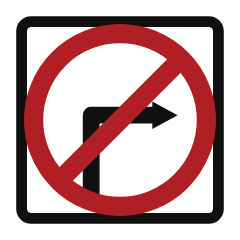
17. A driver stopped at a red signal wants to turn right and this sign is posted at the corner. What is permitted?
Show answer
Answer A: Nothing: the turn is barred whether the signal is red or green
The restriction works independently of the signal, so the usual permission to turn right after stopping at a red light does not exist where this sign is posted.
-
18. Rain is falling and the outside temperature reads close to 32 degrees Fahrenheit. Why is that dangerous?
Show answer
Answer A: The rain can freeze on contact and glaze the road with ice
Near freezing, rain landing on cold pavement can turn to a glaze of ice almost at once, so a road that looks merely wet may have no grip at all.
-
19. Which of these is a known cause of a high speed wobble?
Show answer
Answer C: Incorrect tire pressure or a load carried too far back and too high
Wobble is usually traced to tires, wheels, loading or poorly mounted accessories such as a windshield or fairing, so check pressures and how the machine is loaded.
-
20. How can loose spokes be found on a spoked wheel?
Show answer
Answer B: By tapping each spoke and listening for a dull sound instead of a clear ring
A correctly tensioned spoke rings when tapped, while a loose one gives a flat, dull note that stands out from the rest of the wheel.
-
21. Cones and drums mark a shifted lane through a work zone. What should you do?
Show answer
Answer A: Follow the path that they mark and stay inside it
Channelizing devices define the temporary travel path, and the space on the other side of them belongs to the workers.
-
22. A school sign combined with an AHEAD plaque, or with a plaque giving a distance in feet, forms an assembly that
Show answer
Answer B: warns of a school crossing located further along the road
The school advance crossing assembly is placed before the crosswalk to give drivers notice, while a different assembly marks the crossing itself.
-
23. What is the best way to handle fatigue on a long ride?
Show answer
Answer C: Take rest breaks regularly and dress to keep wind and cold out
Wind, vibration and cold tire a rider faster than a driver, and the safe answer is planned breaks and protective clothing rather than pressing on.
-
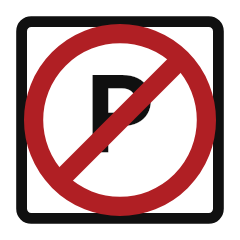
24. Why is this restriction so common beside fire hydrants, crosswalks and intersection corners?
Show answer
Answer C: To keep sight lines open and leave access for emergency crews
A vehicle left in those places hides pedestrians from approaching drivers, blocks the path of turning vehicles and can keep firefighters from reaching a hydrant.
-
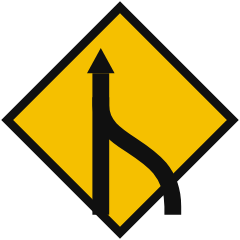
25. What is the safest way to deal with the situation this sign announces?
Show answer
Answer B: Match the speed of the other traffic stream and open a gap so vehicles can blend without hard braking
Blending works when speeds are matched and gaps are opened, so nobody has to brake hard or swerve where the two streams come together.