
Missouri DOR Motorcycle Practice Test 30
- Questions25
- Correct to pass20
- Passing score80%
- Minimum age15 years 182 days
-
1. The added lane warning sign tells a driver that
Show answer
Answer A: an extra lane begins ahead, so entering traffic does not have to merge into an existing lane
Where a lane is added, traffic entering the roadway gets a lane of its own, so merging is not required, although drivers should still watch the vehicles beside them.
-
2. An oncoming car is waiting to turn left across your path at an intersection. What is the safest response?
Show answer
Answer D: Slow, cover the brakes and pick a lane position that keeps an escape path
A car turning left in front of a rider is one of the most common motorcycle collisions, so the rider prepares to stop or swerve rather than trusting the driver to wait.
-
3. How do the traffic laws apply to riders traveling in a group?
Show answer
Answer D: Every rider is responsible for obeying the law on their own machine
Riding in company changes nothing legally, and each rider answers individually for speed, signals and every other rule of the road.
-
4. A Missouri driver approaches a stopped emergency vehicle with lights flashing but cannot safely change lanes. What does the law require?
Show answer
Answer C: Slow to a safe speed for conditions and pass with due caution
When changing lanes is unsafe or impossible, Missouri requires the driver to proceed with due caution and reduce speed to a safe speed for road conditions.
-
5. You have passed a large truck and want to move back into its lane. What should you see first?
Show answer
Answer B: Both of its headlights in your rear-view mirror
Seeing both headlights in your mirror means you are far enough ahead to be out of the truck's front no-zone before you move over.
-
6. Another driver has pulled out to pass you. What should you do?
Show answer
Answer A: Stay in your lane, keep your speed steady or ease off, and let the pass finish
Accelerating while being passed forces the other driver to stay in the opposing lane longer, so the safe response is to hold or slightly reduce speed and stay right.
-
7. What is true about driving away from a crash you were involved in?
Show answer
Answer B: It is a serious offense, even if the other driver has driven away too
Leaving the scene is a criminal offense in every state, and the behavior of the other driver does not excuse it.
-
8. You feel drowsy, so you open a window and turn the radio up. What does that achieve?
Show answer
Answer B: Very little, because the drowsiness comes back
Cold air and loud music are not sleep, so the alerting effect lasts a minute or two and the driver is soon just as sleepy and closer to a lapse.
-
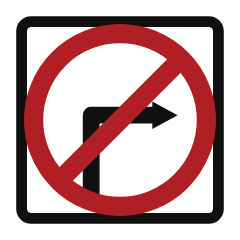
9. A driver's destination lies along the street to the right, and this sign stands at that corner. How should the driver reach it?
Show answer
Answer D: By going on and using a later intersection where turning is allowed
When a movement is barred at one corner the driver has to reroute, normally by continuing and coming back to the destination from a permitted approach.
-
10. Another driver takes a right of way that was legally yours. What should you do?
Show answer
Answer A: Give way to the other driver and avoid the crash, whatever the law says
Right of way is something you give, not something you take, and being in the right is no protection in a collision.
-
11. You are entering a freeway using an on-ramp with an acceleration lane. What is the correct technique?
Show answer
Answer C: Use the acceleration lane to reach the speed of traffic, then merge into a gap while yielding to traffic already on the freeway
The acceleration lane exists so you can match the speed of freeway traffic before merging, and drivers already on the freeway have the right-of-way.
-
12. Parked cars block your view of a cross street you are about to enter. How should you proceed?
Show answer
Answer A: Edge forward slowly until you can see along the cross street, then go
Creeping forward buys a view of the cross street a little at a time, and it keeps the rider slow enough to stop if something is coming.
-
13. Why should a rider avoid painting a helmet or cleaning it with strong solvents?
Show answer
Answer D: Chemicals can weaken the shell and the liner without showing it
Solvents and some paints attack the shell and the foam, so use mild soap and water and follow the maker's instructions to keep the helmet's protection intact.
-
14. How should following distance change when you ride at night?
Show answer
Answer D: Open it up to three seconds or more
Less light means hazards appear later, so a rider should slow down and stretch the following distance to three seconds or more.
-
15. Your green left-turn arrow goes out and a steady green ball stays lit. What may you do?
Show answer
Answer A: Continue turning left, but only after yielding to oncoming traffic
When the arrow ends and a green ball remains, the turn changes from protected to permissive, so it is still allowed but oncoming traffic goes first.
-
16. The traffic around you is moving well above the limit on a wide highway. What should you do?
Show answer
Answer D: Keep to the limit and stay to the right, letting faster traffic pass
The limit is a legal maximum, and the safe way to differ from the traffic around you is to keep right and let it go by.
-
17. A clutch cable adjusted with no free play at all causes what problem?
Show answer
Answer B: The clutch may slip and never fully engage
Without a small amount of slack the release mechanism keeps a light load on the plates, so they slip instead of transmitting full power.
-
18. Where is a road work ahead sign placed?
Show answer
Answer B: In advance of the work space or detour, so drivers are warned before reaching it
Advance warning signs are placed upstream of the work space or detour so that drivers have time to slow down and change lanes before reaching the activity.
-
19. A notification appears on your smart watch while you are driving. What should you do?
Show answer
Answer B: Treat it as you would a phone and leave it
A watch screen demands the same eyes and the same attention as a phone, and a wrist is no safer a place to read a message than a dashboard.
-
20. How should cargo be carried on a motorcycle?
Show answer
Answer D: Kept low, in saddlebags or at about seat level
Keeping the load low preserves the center of gravity and the normal handling of the motorcycle, while a high load makes it top heavy and unstable.
-
21. Fog thickens until you can barely make out the vehicle ahead. What is the safest action?
Show answer
Answer A: Slow right down and, if needed, leave the road at a safe place
In heavy fog the only safe speed may be very low, and if it drops below what the road allows, the answer is to pull well clear of the traffic lanes.
-
22. What must a driver be ready to do along the stretch of road where this sign is posted?

Show answer
Answer D: Slow down and stop for a child who steps into the roadway
Children misjudge speed and distance and act without warning, so the driver reduces speed, covers the brake and scans the sidewalks and parked vehicles.
-
23. A driver has to stop for a train at this sign. How far back from the nearest rail should the vehicle be held?

Show answer
Answer C: No closer than roughly fifteen feet
A train and its load overhang the rails, so stopping no closer than about fifteen feet keeps the vehicle outside the space the train actually sweeps.
-
24. What is the safest way to pass a bicyclist on a road with two lanes going your way?
Show answer
Answer D: Change lanes completely, as you would for a car
A bicycle is entitled to the room a vehicle needs, and moving into the next lane gives the rider space to swerve around a drain or a pothole.
-
25. When may you stop on the shoulder of a freeway?
Show answer
Answer A: Only in an emergency, moving completely off the travel lanes and switching on your hazard lights
The freeway shoulder is reserved for emergencies and for disabled vehicles, and a vehicle stopped there must be clear of the travel lanes with hazard lights on.