
Missouri DOR Motorcycle Practice Test 40
- Questions25
- Correct to pass20
- Passing score80%
- Minimum age15 years 182 days
-
1. With the engine off, a rider turns the handlebars fully to the left and to the right. What is being checked?
Show answer
Answer A: That the steering moves freely and no cable is pinched or binding
Cables and wiring that catch at full lock can hold the throttle open or stiffen the steering exactly when the rider needs a tight turn.
-
2. How does going a long time without sleep compare with drinking?
Show answer
Answer A: It can impair a driver in much the same way
Long periods awake produce slow reactions, poor judgment and lapses of attention that resemble the effects of alcohol, which is why fatigue counts as impairment.
-
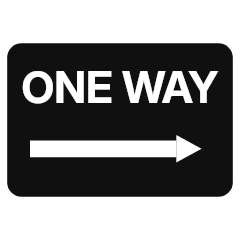
3. A driver disregards this sign and turns so as to travel against the direction it establishes. What is the immediate danger?
Show answer
Answer D: The driver will face traffic head on, because every lane comes the other way
Turning against the established direction puts the vehicle nose to nose with all the traffic on that street, which is why the mistake has to be corrected at once.
-
4. Cannabis is legal for adults in some states. What does that mean for driving?
Show answer
Answer C: Driving while impaired by it is still an offense
Legal possession has nothing to do with driving law, and every state treats driving while impaired by cannabis as an offense.
-
5. What visual acuity does Missouri require to pass the driver license vision test?
Show answer
Answer D: At least 20/40 with either eye or with both eyes
Missouri's standard is at least 20/40 acuity with either or both eyes, together with peripheral vision of at least 55 degrees in each eye.
-
6. What should a rider understand about the horn on a motorcycle?
Show answer
Answer A: It is often weak and may not be heard, so it never replaces an escape route
A small horn competes with a closed car, a radio and traffic noise, so a rider plans a way out instead of trusting the horn to be heard.
-
7. You reach a stretch of road covered by moving flood water of unknown depth. What is the correct decision?
Show answer
Answer D: Turn around and take another route
About a foot of moving water is enough to carry away most cars, and the roadbed under the water may already be washed out, so the only safe choice is to turn around.
-
8. You turn from asphalt onto a loose gravel road. What should you do about your speed?
Show answer
Answer D: Lower it, since grip is reduced and stopping takes longer
Loose gravel gives far less grip than pavement, so speed must come down for both steering and stopping.
-
9. Why can an oncoming vehicle that looks comfortably far away leave you far less room than you expect?
Show answer
Answer D: You and that vehicle close the gap at the sum of both your speeds
Two vehicles approaching at 55 mph each close the distance between them at about 110 mph, so the gap disappears in half the time you would expect.
-
10. A police officer is directing traffic at an intersection and waves you through a red light. What should you do?
Show answer
Answer C: Follow the officer, whose directions come before signs and signals
Directions given by a police officer or an authorized flagger override signs, signals and pavement markings.
-
11. What is the correct technique for a maximum effort stop in a straight line?
Show answer
Answer A: Squeeze the front lever progressively and press the rear pedal, staying upright
Both brakes together give the shortest stop, the front is squeezed progressively as weight transfers forward, and the machine must be upright with the bars square.
-
12. You must cross tracks or pavement seams that run in nearly the same direction as your path of travel. What should you do?
Show answer
Answer C: Move far enough away to cross at an angle of at least 45 degrees, then turn sharply across
A shallow crossing lets the groove catch and steer the front wheel, so the rider sets up to cross at 45 degrees or more and makes one deliberate turn across it.
-
13. You have shut the engine off with the kill switch because the throttle stuck open. What comes next?
Show answer
Answer D: Keep the clutch in, brake to a stop off the road, and find the cause
With the engine off and the clutch pulled in the motorcycle is only coasting, so brake to a stop clear of traffic and inspect the throttle cable and grip before restarting.
-
14. What does a sign reading Slower Traffic Keep Right require?
Show answer
Answer C: Traffic moving slower than the general flow must use the right-hand lane
The sign applies to any vehicle traveling below the speed of the traffic around it, which must keep right so faster vehicles can use the lanes to the left.
-
15. On a regulatory sign, what does a red circle with a diagonal slash drawn over a symbol mean?
Show answer
Answer D: The movement or action shown by the symbol is prohibited
A red circle with a diagonal slash is the standard way of showing that the movement pictured inside it, such as a U-turn or a right turn, is not allowed.
-
16. Under Missouri's electronic communication device law, what is prohibited while the vehicle is in motion?
Show answer
Answer A: Physically holding or supporting a cellphone with any part of the body
Missouri bans holding or supporting a phone with any part of the body, along with manual texting and video recording or watching; voice-operated, hands-free and navigation uses remain allowed.
-
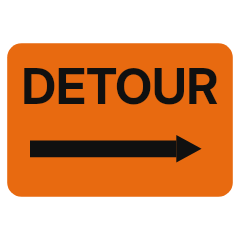
17. Once a driver has joined the route this sign begins, how is the rest of the way marked?
Show answer
Answer B: By further markers of the same kind at each turn, until the original road is rejoined
The alternate route is signed continuously, with a marker at every turn, so a driver with no local knowledge can follow it back to the original road.
-
18. How does riding in a formation change your responsibility for your own space cushion?
Show answer
Answer C: It does not change it, because each rider still manages their own space and decisions
A formation organizes the group, but every rider remains responsible for their own following distance, escape paths and riding decisions.
-
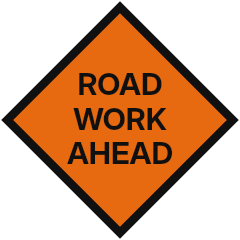
19. How should speed and following distance be adjusted beyond this sign?
Show answer
Answer D: Cut speed and leave a longer gap, because traffic can stop without warning
Traffic in these areas stops and starts unexpectedly and there is little room to steer around a problem, so extra space is what prevents a rear-end collision.
-
20. A pedestrian has stepped into a crosswalk at an intersection ahead of you. What is your obligation?
Show answer
Answer C: Yield and let the pedestrian finish crossing before you proceed
Drivers must yield to pedestrians in a crosswalk, and an intersection has a legal crosswalk whether or not lines are painted on the pavement.
-
21. A strong wind is blowing steadily across the road from your left. How should you ride?
Show answer
Answer A: Move toward the left of the lane and lean into the wind
Riding on the windward side of the lane leaves room to be pushed without leaving the lane, and a slight lean into the wind holds the line.
-
22. What should the operator do before a bump, a sharp turn or a sudden stop?
Show answer
Answer C: Warn the passenger so they can brace for it
A warning lets the passenger tighten their grip and prepare, which keeps the passenger weight from shifting unexpectedly at the worst moment.
-
23. Why should a rider glance down at the sidestand before pulling away?
Show answer
Answer A: A stand left down can catch the road and lever the rear wheel off the ground
A sidestand that is still down will dig into the pavement in a left turn and can lift the rear tire clear of the road.
-
24. Besides air pressure, what should a rider look for when inspecting the tires?
Show answer
Answer B: Tread depth, cuts, embedded objects and uneven wear
Worn or damaged tires lose grip and can fail suddenly, and uneven wear also warns of a pressure or alignment problem.
-
25. Permanent signs must be retroreflective or lighted so that
Show answer
Answer A: they show the same shape and color at night as by day
Retroreflective sheeting throws headlight light back to the driver, so a sign keeps its daytime shape and color after dark.