
Missouri DOR Motorcycle Practice Test 20
- Questions25
- Correct to pass20
- Passing score80%
- Minimum age15 years 182 days
-
1. A small signal face beside a bikeway shows red, yellow and green lenses that each carry a bicycle symbol. Whom does it control?
Show answer
Answer C: Bicyclists using that crossing or bikeway
A bicycle signal face governs bicycle movements only, and people on foot at the same corner still follow the pedestrian signal.
-
2. How does a rider open the throttle to increase speed?
Show answer
Answer C: By rolling the right handgrip toward the rider
Rolling the right handgrip toward you opens the throttle, and rolling it away closes it so the engine slows.
-
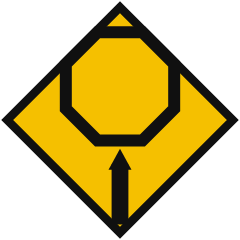
3. What is the driver expected to do after passing this sign?
Show answer
Answer A: Begin slowing so that a complete stop can be made at the intersection ahead
It is used where the control at the intersection stays hidden until late, so braking should begin here rather than at the stop line.
-
4. A traffic light ahead of the group turns yellow as the leader approaches it. What should the leader do?
Show answer
Answer C: Stop normally and let the group be split by the signal
Keeping the group together never outranks obeying the signal, and the riders left behind simply catch up at the next stop.
-
5. How should a group decide how often to stop for fuel?
Show answer
Answer A: By the range of the machine with the smallest fuel tank
Planning around the smallest tank keeps the group from splitting up when one rider has to leave the route to look for fuel.
-
6. How much room should a rider try to leave when passing a line of parked cars?
Show answer
Answer A: Enough to clear an opening door, roughly the width of a car door
A door swings out about the width of a door, so ride at least that far from parked vehicles and slow down wherever you cannot leave that much space.
-
7. Why should a load never be fastened to the handlebars or the front forks?
Show answer
Answer D: The weight upsets the steering and makes the front end handle unpredictably
Anything hung on the steering moves with it and changes how the motorcycle turns, which is why loads belong low and behind the rider instead.
-
8. A driver is following you far too closely and you have a turn coming up. How should you slow down for it?
Show answer
Answer B: Signal early and slow gradually well before the turn
Early signals and gentle braking give a tailgater the time and distance they have failed to leave for themselves.
-
9. Your right-turn lane shows a green arrow while the through lanes face a red ball. What does that mean?
Show answer
Answer C: Only the right turn is allowed, and it is protected while the arrow lasts
A green arrow gives a protected movement in that direction only; the red ball still stops the through traffic in the other lanes.
-
10. What is Missouri's uniform maximum speed on roads outside an urbanized area that are not interstates, freeways, expressways or lettered routes?
Show answer
Answer A: 60 mph
All other roads and highways outside an urbanized area carry a 60 mph uniform maximum limit under Missouri law.
-
11. You realize your tires are running on ice. Which set of inputs is safest?
Show answer
Answer C: Gentle steering, no sudden braking, and no sudden acceleration
Whatever grip is left is used up at once by any sudden input, so every movement of wheel, brake and accelerator must be slow and small.
-
12. Does wearing properly fitted earplugs stop a rider from hearing important sounds?
Show answer
Answer C: No, they lower overall noise while horns and speech still register
Earplugs reduce the wind roar that masks everything else, so riders wearing them often hear traffic more clearly, not less, while their hearing is protected.
-
13. What licensing consequence follows a third Missouri conviction for driving while intoxicated?
Show answer
Answer D: A ten-year license denial
A third or subsequent DWI or BAC conviction in Missouri results in a ten-year license denial.
-
14. You are turning left at an intersection and an oncoming bicyclist is approaching in the bike lane. What must you do?
Show answer
Answer B: Yield and complete the turn only after the bicyclist has passed
A bicycle in the roadway has the same right of way as a vehicle, so a left-turning driver must yield to an oncoming rider just as to an oncoming car.
-
15. You reach an intersection showing a steady red light, and a stop line is painted across your lane. Where must you bring the vehicle to a complete stop?
Show answer
Answer C: Before the stop line
A steady red requires a complete stop before the marked stop line. Where there is no stop line you stop before the crosswalk, and where there is neither, before entering the intersection.
-
16. What is the main advantage of a face shield over goggles?
Show answer
Answer D: It protects the whole face, not only the eyes
Goggles keep wind and debris out of the eyes, but a shatter resistant face shield also protects the rest of the face in a crash.
-
17. How should tire pressure be checked and set?
Show answer
Answer B: When the tires are cold, set to the pressure specified by the vehicle manufacturer
Driving heats the air and raises the reading, and the sidewall number is a maximum rather than a recommendation, so check cold and use the figure on the vehicle placard or in the owner's manual.
-
18. Some drivers believe they can multitask while driving. What does research show?
Show answer
Answer C: The brain switches rapidly between tasks and driving performance suffers
The brain does not truly do two attention-demanding tasks at once; it alternates between them, and the driving task gets less attention each time.
-
19. What do two solid yellow lines down the middle of a two-way road mean?
Show answer
Answer D: Passing is prohibited for traffic in both directions
A double solid yellow line marks a two-direction no-passing zone, so neither direction may cross it to overtake another vehicle.
-
20. What is the first thing to do once your disabled vehicle is stopped on the shoulder?
Show answer
Answer A: Switch on the hazard warning lights so other drivers can see the vehicle
Hazard lights are the fastest way to make a stopped vehicle visible, and everything else can follow once traffic has been warned.
-
21. How should you use your mirrors while another vehicle overtakes you on a multilane road?
Show answer
Answer C: Follow it from the inside mirror to the side mirror and then to your own view
Handing the vehicle from one mirror to the next keeps it in sight through the blind spot instead of losing it there.
-
22. How can you tell a tire has reached its wear limit without measuring it?
Show answer
Answer C: The wear bars across the grooves become level with the tread
Molded bars sit at the bottom of the grooves. Once the surrounding tread has worn down to them, the tire has reached the end of its safe life.
-
23. When should you move into the lane you need for a turn?
Show answer
Answer D: Well before the intersection, as soon as you know your route
Getting into the correct lane early lets other drivers read your intentions and keeps you from making a sudden lane change at the corner.
-
24. As you approach an intersection, what is a sound search pattern?
Show answer
Answer A: Look left, then ahead, then right, then left again before you enter
Traffic from the left reaches the rider first, so it is checked first and then rechecked, with the road ahead and the traffic from the right covered in between.
-
25. When must a Missouri driver file an accident report with the Department of Revenue?
Show answer
Answer A: Within 30 days, if someone was uninsured and damage tops $500
Missouri requires an accident report within 30 days when the crash happened in the state, someone involved carried no liability insurance, and there was injury, death or property damage over $500.